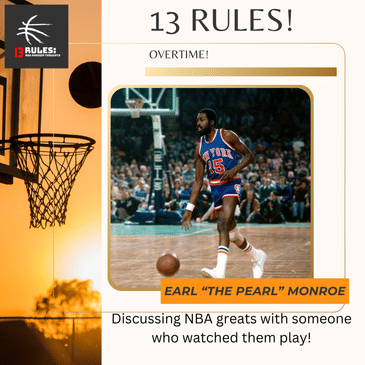
13 Rules Overtime!: Earl "The Pearl" Monroe
===
Jose: [
00:00:00] All right, it's time to talk basketball, off season basketball. I'm Jose Salviati, editor at ThePeachBasket. net. He's Steve Purciello, a long time educator, vice principal, high school coach, and athletic director. And this is the 13 Rules Random NBA Thoughts Overtime Podcast. During the NBA off season we're going to discuss NBA stars from the 60s, 70s, and 80s.
And we're going to talk about them by discussing them with someone who watched them play. which to me is objectively pretty cool. What made that guy special? What player today most resembles that player? And what is Steve who seen, has seen these guys play? What's his greatest memory about that player? To date we've discussed Will Chamberlain, Sam Jones, Rick Barry, Pistol Pete Maravich Jerry West, John Havlicek, Oscar Robertson, and Bill Russell.
All time greats. Today we're going to discuss another player with two, who to me has [
00:01:00] an absolute incredible nickname, following Pistol Pete. This player is an NBA champion in 1973, four time NBA all star, all NBA first team, NBA rookie of the year, and an NBA anniversary team, 50th and 75th best player.
Today, we're discussing the career of Earl, the Pearl Monroe. And Earl Monroe is interesting to me because this is a guy, and Steve, you and I were just talking about this is a guy I know, I know the name, I've heard the name, I honestly don't think I can tell you anything about his game, which is embarrassing to me, but listen, I'll be straight, I don't know anything about his game, I never saw him play.
Think he's a point guard. And that's about where my knowledge begins and ends. I've done a little bit of research, so I know a little bit more now, but before then, nothing, but this is an NBA all time great 50th and 75th anniversary team. Tell us about Earl Monroe. Let's start with what made him special.
Why is he so good?
Speaker 2: He was just one of the [
00:02:00] greatest one on one players that have ever played the game. It started out. He went to Winston Salem College, which at the time was a D two and it was in the south. He grew up in Philly. But he went there. Clarence Big House games was a Hall of Fame coach was his coach there.
And he played for them. I believe they won the Title. I think his senior year in high school and college the D2 would be a D2 college, I think it was just called the college division then, but he won the title there, and then he was a first round pick number, the second guy taken in the draft, I believe in 67.
And after Jimmy Walker, who went to Providence was a great player too, but he didn't quite have the career and the professionals, but he was the second guy. Chosen by the Baltimore Bullets. Back then, Baltimore, the Bullets played downtown in Baltimore. And him and another guy you might've heard of Wes Unseld.
We're both young and they were with the bullets and the bullets [
00:03:00] went from like a mediocre to not a good team. All of a sudden the next year they had the best record in the East. They lost in the playoffs to the Knicks and the Knicks were beaten by Oh, the Celtics in the, in that year, the 69, I believe.
And then but. The point being they took a team like that. Unseld was revered for his quick outlet pass and his rebound. He was only 68, but Monroe was just a one on one player was unstoppable. It's ironic. He didn't make the all stars one year. And some household names made it over him in the east, guys like Tom Van Arsdale and Flynn Robinson, which is wild with that, that he didn't make the all star team in one of those years because he did take this bullet team.
Now he, he lasted with the bullets for four or five years. And I think one year they went to the finals and they lost they lost in the finals. But now last year with that, with gene shoe coaching. [
00:04:00] But they lost in that year. Then after that, he wanted money. They didn't get paid a lot. Baltimore was a smaller market.
Even then they had, they really didn't want to come up with the money. So now he wanted to get traded. He really wanted to go to Philly where he lived and the bulls. But the Knicks came along and dealt him. And that's where most people remember him. They don't remember those early years when he was a one man gang, literally taking a team.
He did have some other players in Gus Johnson. It was an Hall of Famer also, but he was the game. He's what turned that team into a good team. But now with the Knicks ended up. Getting him. He made a thread even to go to the ABA at the time, I believe in Indianapolis, but But the Knicks got him for Dave Stallworth and Mike Reardon.
Reardon did have a nice career with the Bullets, but Stallworth Nothing, he was the seventh man But the point becomes he comes to the Knicks the big talk is how could him he and Wall Frazier play together? [
00:05:00]
Jose: Yeah,
Speaker 2: It'll never do I'll give you a little story and not a little story but the end of it You Turns out to this very interesting at the end of it.
Those two, that tandem is the only tandem in the all time top 75 players selected. In other words, no other pair of guards ever made it. His scoring went down and he was less and less a one on one player, but he was great. And he always would come up with big baskets for the Knicks. And that I remembered real well, and he was always tough.
Frazier was better. It was an all around great. Frazier. But he was just such a great offensive player when they needed it. And everybody said he couldn't defend. He did a decent job as a defender. So he fit into that. And I believe the first year they went to the finals, I think they lost to the Lakers in 72 with the Knicks.
When the Lakers had that great team and had that at the time record winning streak, and then the next year they did play the Lakers again they [
00:06:00] beat the Celtics, in fact, in seven and right before that, and then they went on to play the Lakers and the Lakers they beat the Lakers fairly easily I believe it was four to one and they became the world champions.
He continued with the Knicks for a couple more years and really had a great career hall of fame in 1990, I believe. He made the anniversary team in 50 and 75 with the NBA and he was just a great player and what's interesting is how, I think the biggest story when he came to the Knicks is how he, it didn't matter that he was not the one on one player anymore.
He could still do it, but it didn't matter as much as the winning. And him and Frazier became, and they're still friends, pretty great friends, but they became a great guard tandem. That was really difficult to defend. That,
Jose: that, that's interesting. And I, this is all new to me, which is really cool.
I'm looking at Earl's numbers right now. 24 points is rookie year, [
00:07:00] 25, 23, 21, 21. And then just like you said, Gets traded falls off a cliff goes from 21 to 11 11 15 14 Now today's players aren't gonna do that, right? How do you get a ball? First off I think even today's gm isn't going to take a ball dominant guard and pair them with a ball dominant guard How did that even work?
Speaker 2: That was, and if I remember right, that was like a big thing in the, and I grew up in the New York area. It was a big thing. These guys will never be able to play together. And they had someone who I consider one of the greatest coaches ever read Holtzman coaching it. And Holtzman was more of a defensive coach.
And, but he also got guys to play hard and somehow that fit together. And I think Frazier also helped it. And I think the money wasn't nearly what it is today. So I think winning was very important, more, more so than [
00:08:00] today. I think guys coming to the NBA today. Yeah, they want to get that first big contract and they'll worry about winning.
But, and that takes five years or so to get that contract where, then they weren't making money. That would be life changing where, they really don't have to do anything for the rest of their lives. These guys all, when they left the game, they had to find other things to do, to make some money.
So it was a different thing then. And winning had much higher, much, much higher value. So him winning a title with the with the Knicks was just a big thing because of
Jose: that. And it sounds to me like that's what made it easier for him as a player to take that back seat to the guy, he obviously I shouldn't say obviously, but I assume he knew this guy's better than me.
So I'm going to go ahead and just to be a complimentary piece and win a title.
Speaker 2: Better than
Jose: him in the
Speaker 2: all around
Jose: game
Speaker 2: the thing you have to [
00:09:00] like With the knicks it always seemed or monroe always made big plays and so down the stretch of a game or something he would You know not take over but he would get a big basket or two in there The knicks were loaded back then.
Dave debush was a great shooter great defender bradley I know he's, hyped very well, but I didn't see him. But Willis Reed was great. They were loaded. Think of the team. These are hall of famers. In fact, I believe all five are all the favors. It tells you, how good they were and each of them had to somewhat.
Oh, and with their ego and to win games, don't forget again, and I'm off the subject, but Willis Reed walking out, how many people in today's game would do that? They wouldn't, because he was, he had to get shot up to play that game. So the whole, I guess I say that to tell you that the whole game, And the [
00:10:00] attitude around the game was completely different.
Now we're all shocked when we hear a young players talk about, I just want to win. What are you kidding? So it's a different, it's a different game and I don't blame them because they want to make their money.
Jose: Yeah. Which kind of leads us to a great segue, right? To far and away the best part of this series for me.
And that is when we take these all time greats and try to compare them. To a player today. And the way you encapsulated it to me is absolutely perfect. Cause we're talking about a player. Who was an all star a rookie of the year averaging 20 points plus, and then he goes to a team and takes a backseat to a player who's better than him.
So who's going to do that today? And a player who values winning over anything else, but that aside, maybe we could just talk about his game, the style of play, who today is most like Earl DePerel Monroe.
Speaker 2: This will be the first time I'm prepared for [
00:11:00] this one. I'd have to, I thought about this a little bit, Alan Iverson.
In a lot of ways, in a lot of ways Monroe Black Jesus was his name cause he was just incredible. Schoolyard great and all that. But Monroe he would get you in the lane and he would like juke you a few times. The big knock back then was he's a playground player. He was, because it was all playground basketball.
It would take you one on one and beat you. Iverson did that in a lot of ways. So I guess it would be Iverson, but it'd be very difficult to find anybody, with that one on one skill that he had.
Jose: And is there anybody in we, I think we talked about this before, but skill aside which is tough, cause that's a big part of what makes him great. Is there anybody today that you think would take a backseat to another player? In order to win championships, right? We know [
00:12:00] Kobe and Shaq, right? They fought.
They would have likely would have won more championships. There's Kobe. If they would have, had that kind of relationship that, that, that role of Pearl and while Frazier had, anybody would have done that today or could do that today, I
Speaker 2: think, I think Jalen Brown has done it. Oh, good call. I think he's done it.
But don't forget. He's getting big time money. It makes it easier. Oh, it makes it real easy. And Boston's a little bit of a different animal because you're nobody unless you win a title. Yeah. And now he's got that on his resume as does Tatum. So that's a whole different thing, than a lot of, a lot of other places or a lot of other teams.
And generally when two guys like that come together, there's going to be a breakup at some point in today's NBA where then, they, Monroe stayed there longer than Frazier. And Frazier later in his career was traded to Cleveland where Monroe was a Nick. Through the years.
Jose: Yeah.
Speaker 2: Oh, it's a little bit different.
[
00:13:00] In that way.
Jose: Yeah, and for those watching on video, we're showing a few highlights of his game and dude's slippery, man. And he seems to be, I haven't seen one mid range jump shot. Everything's to the hoop. Look at the
Speaker 2: body, look at the body on him though. He's got that and by the way his big thing, that's his big thing.
They always, he always said, I can jump. What is it? I can jump. I'll stay up there as long as I have to get the shot off. And if you watch a lot of his stuff is on the way down and just, he does things that were just, incredible. He was just, when he was with the bullets, he was just pure fun to watch.
And, back then again, they'd have the games on Sunday and you'd watch him or a Nick game. See, there he is again going, on the way down shooting. That's so
Jose: weird. And again, I'll try to describe this, the shot we just saw. He literally jumped up and on the way down, it seemed like he clutched the ball and shot it on the way down.
And it was swished. It just went right in [
00:14:00] really odd, but
Speaker 2: yeah. He just, it's not a shame. I guess it's great that he played with the Knicks, but it's a shame that he never like, he, in his own way, didn't have the shooting range of marriage, but in his own way could do things with the ball.
Willie we haven't seen much and that would be, and also he had the knack of drawing fouls. He had the whole package, I guess the best way to put it. And it's a shame, not as a knock to the Knicks, but it's a shame because if this guy, if he played on teams that like where he had to score, wow.
He, people would have really understood how great he was.
Jose: Yeah, I think we've talked before about, fit and being on the right team. And I can't help but think that, I don't want to speak for Earl Monroe, but he, he had a great career. He won a championship.
I think he probably really happy with the way things worked out. But to your [
00:15:00] point, right? Yeah. I think if he was in a different situation, he probably, he probably would have continued to average those 20 points that he did his first four or five years of his career. And we'd be having a different conversation.
But all right. Awesome. Again, though,
Speaker 2: we just for people who, think about Who are most people younger than me, but way younger than me, there was no three point shot, right? Yeah, telling yourself that when you look at his 24 points again, not saying he was a great would be a great three point shooter.
But the point being, there was none. So averaging 24 is, pretty good, in the game, and by the way, the making him a top 75, I think it was 58. Yeah. But making him a top 75 player, even though his numbers weren't good. After he left Baltimore, it tells you the respect that, the NBA had for this guy.
Jose: Yeah, we're gonna leave it with this. And we didn't actually prepare this question, [
00:16:00] but this is always the last one I ask. When we talk about certain players, there's an iconic moment for each player, right? Kareem's got the hook, not that we've talked about Kareem. Jerry West has got that, that 68 foot shot, whatever it might be.
Don Nelson. We've talked about that. It was there a particular moment, a game that you saw a favorite memory or something, because this is where Earl Monroe to me is. A mystery because I can't place him with any particular moment. When you think of Romano what comes to mind?
Speaker 2: I think about this guy and back then public, it wasn't publicized like things are today back then.
You had this guy from Winston Salem player for Baltimore. And I had never seen anybody because he had swivel hair. He could do so many different things. And I remember him playing for Baltimore more and I remember the Knicks. I saw many more games, but I remember the game of the week on a Sunday watching this guy and just the moves and the things he did just sitting there and he was [
00:17:00] a one man gang offensively.
So that's the thing that really comes to me with the Knicks. It was more of a five man group and, they all could play and they can all score. So it was a little bit, a little bit different. And even with the Knicks as time went on, cause don't forget, he came after the Knicks won the first championship after Willis Reid walked out there and his, he, Willis Reid was shot.
I don't think he could jump over a phone book after, after that. Injury. Yeah. Yeah. But Jerry Lucas came along and he became their center and he could shoot from 30 or 20. He could he would shoot at the top of the key all night and kill a team. And he was a great rebounder. So it was another, another hall of famer.
replacing a Hall of Famer, although Will is stuck around for a while. But, so they always had five great players. If you want to say Bradley was one, but they had five great players on the court.
Jose: The Allen Iverson example, I'm sorry. The Allen Iverson was really more Baltimore [
00:18:00] bullets.
Earl Monroe.
Speaker 2: Yeah. Yeah. And then that's the part I re I enjoyed because Wow. And, I'd look forward when they were on, and they weren't on a lot. Usually it was Boston and Philly or Boston, sure. They would be on most of the time, but when they were on I, I'd look forward to it or when they played the Knicks going way back, but back then again. If they're playing the Knicks, you only get the away games. We didn't get the home games. I naturally, I know Baltimore is on tonight and I want to see it, so that would be just because he was such a great, just great moves and just unstoppable going to
Jose: the basket and there it is.
Let's let's end it there. Great exclamation mark at the end of the career of Earl Monroe from someone who watched him play. I hope you enjoyed learning more about this MBA. Great. I did. I learned a lot today, which is always pretty cool. If you have somebody you want to learn a little bit more about, if Steve watched him play.
We will discuss that player. We're going down the list of the NBA [
00:19:00] greats. We don't have anybody on tap for next week, but we will make sure to add add a subscribe to us. Leave us a comment, man. All that stuff helps a lot. We'd love to hear from you. If you've got a player in mind, otherwise we will pick one and be back next week to talk about another NBA great with someone who watched him play.
Thanks for joining us on 13 rules over time. Steve, we'll talk next week. Take care.